Evidence of Learning: End of 2025/2026
Evidence of Learning: End of 2025/2026
This school year, we continued our hard work towards our goal of “Building Confidence Through Numeracy”. Based on the data collected from the year before (see evidence post from October 2025 for more details), we determined to focus on the following elements this year:
- Continuing to learn and practice different ways to make Math and numeracy fun and engaging for students;
- Developing common mathematical language to support math communication for our students;
- Continue to support teacher professional development to build confidence in their own practice in the hopes that this confidence is mirrored in students.
Our targeted actions
This school year, Mitchell staff did several things to address our school’s learning focus of “Building Confidence Through Numeracy” and the forementioned focal points.
In September, our whole staff attended a workshop at Bridge Elementary. The topic was numeracy and was a strong review of the numeracy teaching skills that staff had worked on last school year.
In November, a committee of four teachers, two school admins and our district Math consultant spent a day collaborating to find strategies to share back to staff to implement common Math language in our school. This was based on feedback from the year before that some of our students did not seem confident when talking about Math as they lacked the language to express their knowledge/abilities. In November, we also implemented our vertical Math hallway! Our goal was to create a space for Math in the school, where students could work collaboratively on Math stories. It has been wonderful to watch students participate and engage in mathematical conversations all year!
In January, all teaching staff participated in collaboration sessions with Mr. Tang, our Math teacher consultant. The focus was on making Math fun in class. Teachers left the session with tons of ideas to make Math interactive and fun. They were asked to try some in class with their students so they could debrief during the next collaboration session.
In April, we hosted Ms. Carole Fullerton. She worked collaboratively with two groups of teachers to develop and model Math lessons in class, followed by a debrief. The idea was to offer direct support in action to teachers and bring it inside the classrooms! In April, we also had our second collaboration session with Mr. Tang, which was a continuation of the learning that occurred in January.
In May, we had the Julia Robinson Math Festival join us for an evening of fun Math games for families and interested staff. This allowed families to have a better sense of what we have been working on in school, and participating staff left with more fun ideas for Math games, activities, and challenges for their classes.
In April and May, we also reorganized our Math room, labeling all manipulatives and Math materials for easy access, in both English and French. This idea came from feedback from staff that they enjoyed using the materials but found them difficult to find and access.
Finally, at our June staff meeting, we looked at and analyzed data from student surveys, FSAs and report cards to assess our progress with our learning goal. The objective of this activity was for all staff to have a strong understanding of where our students are in their Math and numeracy journey, including how confident they are feeling about their Math and numeracy skills.
How are we doing?
Throughout the school year we collected data to better grasp how we were doing with our goal. Data collected was both quantitative and qualitative. We relied on students and teachers’ opinions, feelings and anecdotes, as well as FSA and report card data.
FSA results
We looked at the results from 2025/2026, 2024/2025 and 2023/2024. We were wondering if we would see a difference in our students’ numeracy results from year to year. See results below:
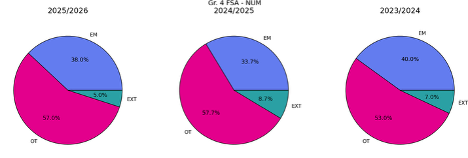
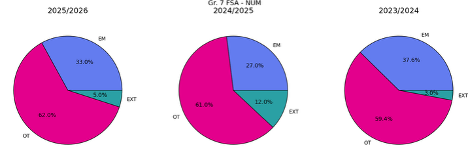
When interpreting this data, we are noticing that there is little change from 2023/2024 to 2025/2026, although there is slight progress. A higher percentage of our students fall in the “on track” or “extending” portion. Several key factors could have impacted test results, including: test anxiety, lack of completion of test for variety of reasons and lack of test preparedness.
Report Card Data
We also looked at the results from 2025/2026, 2024/2025 and 2023/2024 report cards. We were wondering if we would see a difference in our students’ Mathematics results from year to year. We looked at this data using results from all our students. See results below:
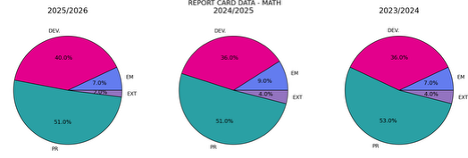
Again, when looking at this data, we notice that there has not been much change in overall results. Several key factors could have impacted these results, including: teachers aligning their assessment more closely to the curriculum following Pro-D opportunities on this topic, students’ skills development and improvement can be slow and steady over time, and the 2025/2026 pie includes results from terms 1 and 2 only.
Student Surveys
In the Spring of 2026, we asked all our primary students (K-3) to tell us: “How do you think you are doing?”. This is what they answered:
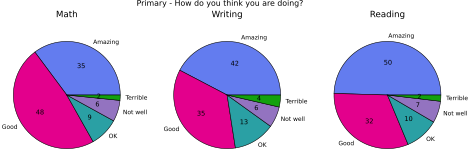
From this data, we can tell that our students are confident in their abilities in Math with 83% of students responding that they feel that they are doing amazing or good. This tells us that they feel confident working on Math.
Our intermediate students (Gr. 4 – 7) were asked to tell us what they enjoyed and what they found difficult in Math.
Amongst the top recurring answers for what they enjoyed the most was “math games”. This is wonderful news as our staff has dedicated a lot of energy learning about making Math fun! It means the effort was worth it. Other top answers were: using technology, worksheets, algebra, addition/subtraction and multiplication.
In terms of what they found the most difficult, students mentioned: tests & quizzes, work sheets, division and problem-solving.
What does this data show us about progress with our goal? First, let’s remind ourselves that our goal is to “build confidence through numeracy”. While test scores and report card data are very important and not insignificant, the slow progress in results that we are seeing is not alarming. We are glad to see progress and as a team, we understand that as our practice grows, so will our students’ progress. What we were excited to notice, though, is that overall, our students are much more confident in their Math/numeracy abilities and that they are more enthusiastic toward their learning. Staff is reporting that students are excited for Math class, that sometimes “they don’t realize that they are learning because they are having so much fun”, and that they often ask for more. Staff also notices that students are better able to communicate their learning using mathematical language both with teachers and each other. Finally, staff expressed that they feel that their students are less “Math anxious” and happier when doing Math.
What now?
As a staff, we feel satisfied that we have reached our goal of “building confidence through numeracy”. We feel that we have created a community of enthusiastic mathematicians who enjoy challenges, especially through play and real-life experiences.
As we tackled Math language, we also realized that literacy skills played a big part in students’ confidence to solve word problems and complete work in Math. When we looked at our literacy report card data we noticed that overall school results were declining from year to year from 2023 to 2026. See chart below:
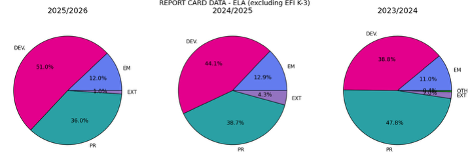
Teachers have started to identify gaps and learning targets for their students more precisely, thanks to the use of literacy assessments.
As we feel successful with our goal of “building confidence through numeracy”, we are looking forward to focus on literacy skills starting next school year. Staff overwhelmingly feel ready to move on as they feel confident that they now have the skills and knowledge to continue to develop their practice in Math/Numeracy. It has been a wonderful journey with our goal over the past two years and we are excited to start all over again with a new goal!
Updated:
Friday, June 5, 2026